01
Professional Training Programs
Public training, workshop intensif, dan bootcamp aplikatif untuk membangun kompetensi siap implementasi.
Pelajari layanan →Professional Training & Competency Development Partner
Potensia Academy membantu institusi pendidikan, perusahaan, UMKM, dan profesional membangun kemampuan yang relevan melalui pembelajaran berbasis praktik dan hasil.
Beyond Training
Pembelajaran yang terhubung dengan implementasi.Mitra pengembangan kompetensi untuk
Our Belief
Pelatihan yang efektif bukan hanya menambah wawasan, tetapi mengubah cara kerja dan meningkatkan kinerja.
Tentang Potensia Academy
Kami adalah lembaga profesional yang berfokus pada pengembangan kompetensi SDM untuk sektor pendidikan dan korporasi, sekaligus mendukung UMKM serta profesional agar lebih siap bertumbuh.
Setiap program dirancang dari tantangan nyata, target kinerja, dan kebutuhan peserta sehingga pembelajaran menjadi relevan, terstruktur, dan dapat diterapkan.
Kenali Potensia Academy →Core Services
Pilih format yang sesuai atau bangun program khusus berdasarkan kebutuhan organisasi Anda.
Public training, workshop intensif, dan bootcamp aplikatif untuk membangun kompetensi siap implementasi.
Pelajari layanan →Program yang disesuaikan dengan tantangan institusi, target kinerja, dan level peserta.
Pelajari layanan →Roadmap SDM, framework kompetensi, serta sistem evaluasi dan monitoring yang terstruktur.
Pelajari layanan →Pembelajaran fleksibel dan terstruktur untuk mendukung akses serta pengembangan kompetensi berkelanjutan.
Pelajari layanan →Flagship Programs
Setiap sektor membutuhkan konteks, pendekatan, dan hasil pembelajaran yang spesifik.
01
Tata kelola, mutu, dan kepatuhan institusi.
02
Produktivitas, branding, dan penguatan organisasi.
03
Fundamental bisnis dan pertumbuhan yang scalable.
04
Kesiapan kerja, kredibilitas, dan keterampilan industri.
Program Terbaru
WORKSHOP PRAKTIK · ONLINE Sukses Audit Mutu Internal (AMI) dengan Bantuan AI Workshop praktik untuk membantu auditor dan pengelola mutu perguruan tinggi menggunakan AI […]
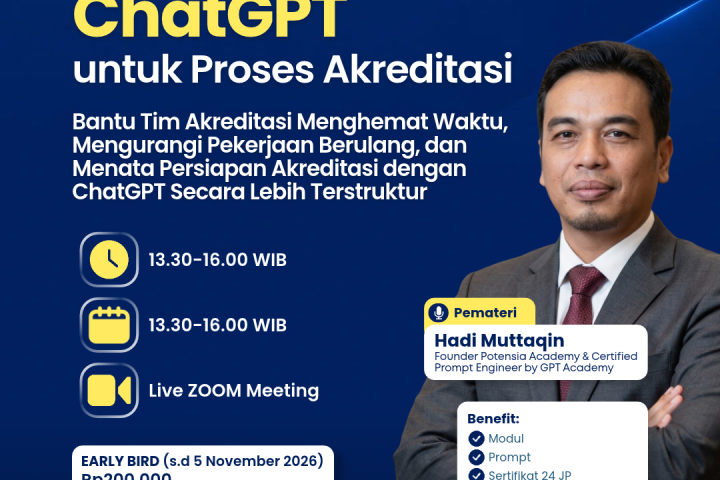
TRAINING ONLINE MEMANFAATKAN CHATGPT UNTUK PROSES AKREDITASI BANTU TIM AKREDITASI MENGHEMAT WAKTU, MENGURANGI PEKERJAAN BERULANG, DAN MENATA PERSIAPAN AKREDITASI DENGAN CHATGPT SECARA LEBIH TERSTRUKTUR […]
Training Online Langsung Praktek Step By Step ChatGPT untuk Akreditasi Lebih Cepat Lebih Mudah Pelajari langkah demi langkah bagaimana ChatGPT dapat membantu tim akreditasi […]
Why Choose Us
Kami memahami bahwa pelatihan sering gagal memberikan dampak ketika tidak terhubung dengan kebutuhan dan implementasi nyata.
Bukan hanya pelatihan satu kali, tetapi proses pengembangan kompetensi yang berkelanjutan.
Peserta tidak hanya belajar, tetapi diarahkan untuk menerapkan dan menghasilkan output.
Program disesuaikan dengan konteks, tantangan, target kinerja, dan level peserta.
Setiap program diarahkan pada perubahan dan hasil yang dapat dipantau serta diukur.
Learning Journey Framework
Proses pengembangan kompetensi dirancang sebagai perjalanan terstruktur, bukan kegiatan yang berdiri sendiri.
Pemberian konsep dan pemahaman inti.
Simulasi dan latihan berbasis kasus nyata.
Penerapan langsung di lingkungan peserta atau institusi.
Pendampingan, umpan balik, dan pengukuran hasil.
Let’s Build Impact Together
Mulai dari tantangan nyata, target kinerja, dan hasil yang ingin dicapai.